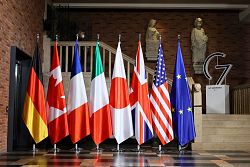
G7: Developments in Yemen, Red Sea Constitute Threat to Regional Stability, Security, Freedom of Navigation
Canada, France, Germany, Italy, the United Kingdom, the United States, Japan and the EU High Representative have restated their commitment to Yemen's unity, sovereignty, independence and territorial integrity, as well as to continue supporting the Yemeni government.
Second Day of International Media Forum on Islamic Civilization Kicks Off in Tashkent
The second day of the International Media Forum “Islamic Civilization: A New Perspective – New Discoveries” commenced today, Wednesday, at the Center for Islamic Civilization in the Uzbek capital, Tashkent.

Gold Rises Over 1 Percent
Gold prices rose more than one percent today, Thursday, as investors digested the U.S. interest rate hike and hints of further monetary tightening, while the rally in oil prices came to a halt.

Al Nassr Beat Al Fateh 3-0 in Saudi Football League
Al Nassr defeated Al Fateh 3-0 in the opening round of the Saudi Pro League, known as the Roshn Saudi League.
Last Update: ،
2026/09/22
Time
02:18:46
Latest News:
 President al-Alimi Receives Reply Message from Emir of Kuwait
Human Rights Ministry Condemns Houthi Missile Attack on Popular Market in Lahj
Arab Foreign Ministers Discuss Regional Developments and Yemen
Dr. Abdullah Bawazir Briefs Senior Democrat on U.S. House Foreign Affairs Committee on Houthi Terrorists ..
Foreign Minister Stresses Importance of Disarming Armed Groups, Supporting State Institutions
Latest News:
President al-Alimi Receives Reply Message from Emir of Kuwait
Human Rights Ministry Condemns Houthi Missile Attack on Popular Market in Lahj
Arab Foreign Ministers Discuss Regional Developments and Yemen
Dr. Abdullah Bawazir Briefs Senior Democrat on U.S. House Foreign Affairs Committee on Houthi Terrorists ..
Foreign Minister Stresses Importance of Disarming Armed Groups, Supporting State Institutions
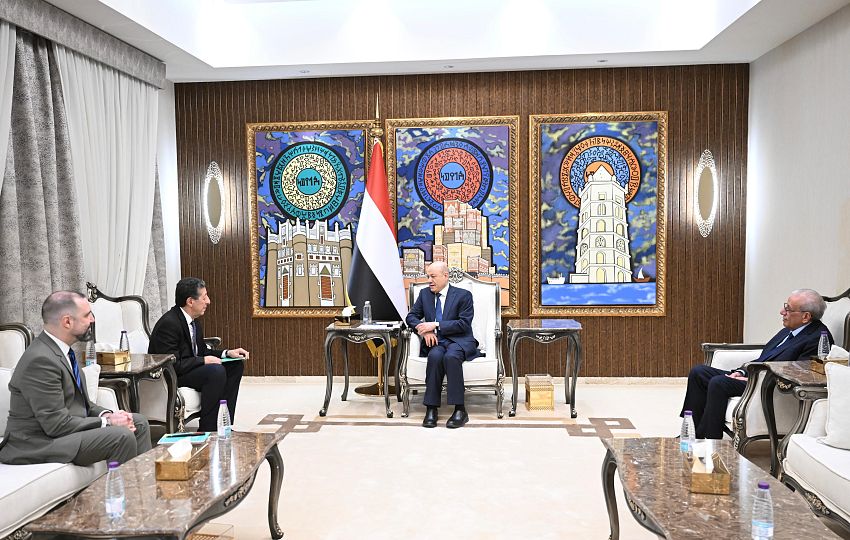
President of the Presidential Leadership Council to European Institute of Peace Delegation: Treating the Houthis as a Normal Actor Is a Structural Error That Threatens to Perpetuate War and Suffering
[10/02/2026 09:36]
RIYADH-SABA
His Excellency President Dr. Rashad Mohammed al-Alimi, Chairman of the Presidential Leadership Council, affirmed that the Yemeni people aspire to a sustainable, long-term peace that does not bypass the state or reproduce violence once again.
During his reception today, Tuesday, of a delegation from the European Institute of Peace, headed by Ambassador Hesham Youssef, His Excellency stressed that “there can be no sustainable peace without one state, one weapon, and one decision.” He added, “The European experience has taught us that peace that bypasses the state is merely a temporary truce, and that all peace attempts which ignore this reality ultimately end by reproducing war.”
President al-Alimi pointed to Europe’s profound experience in peacebuilding after devastating wars, describing it as a laboratory for understanding how to rebuild states after division and how to deter ideological extremism.
He reiterated that the Houthi terrorist militias are not a party to a conventional conflict, but rather a closed ideological group whose project is based on hereditary discrimination, a claimed divine right to rule, and the denial of equal citizenship.
“Here the European approach becomes a guide,” he said. “Just as Europe dealt with Nazism and fascism as existential threats rather than political opinions, treating the Houthis as a normal actor is a structural error that endangers peace.”
The President added that any peace formula must entail ending ideological weapons, dismantling the logic of lineage-based rule and discrimination, guaranteeing equal citizenship, and establishing a state that protects all its citizens.
He emphasized that any peace lacking enforceable guarantees would reproduce violence, noting that such guarantees must include dismantling the militia’s military and ideological structures, criminalizing sectarianism and racism in the constitution and law, preventing the legitimization of faits accomplis imposed by force, and supporting state institutions economically and in security terms.
President al-Alimi stressed Yemen’s need to move from managing the conflict to addressing its root causes, underscoring that peace is not achieved through a balance between a state and a militia, but through empowering the state and ending the sources and cycles of violence.
He reaffirmed that Yemenis do not reject peace, but rather reject a peace that is stripped of statehood and dignity. “They want a peace like Europe’s—one that lasts forever, not an agreement that collapses after two years,” he said.
The President also reviewed the transformations Yemen has witnessed in the recent period, foremost among them the transition from normalizing division to rebuilding the authority of the state, the formation of a new government, ending dual power structures, unifying security decision-making, and improving services. He described these changes as not merely administrative measures, but essential prerequisites for any genuine peace.
In this context, President al-Alimi commended the efforts of the European Institute of Peace and its role in bringing together Yemeni components, tribal leaders, and stakeholders in important discussions on security, peace, the environment, and other key issues.
His Excellency President Dr. Rashad Mohammed al-Alimi, Chairman of the Presidential Leadership Council, affirmed that the Yemeni people aspire to a sustainable, long-term peace that does not bypass the state or reproduce violence once again.
During his reception today, Tuesday, of a delegation from the European Institute of Peace, headed by Ambassador Hesham Youssef, His Excellency stressed that “there can be no sustainable peace without one state, one weapon, and one decision.” He added, “The European experience has taught us that peace that bypasses the state is merely a temporary truce, and that all peace attempts which ignore this reality ultimately end by reproducing war.”
President al-Alimi pointed to Europe’s profound experience in peacebuilding after devastating wars, describing it as a laboratory for understanding how to rebuild states after division and how to deter ideological extremism.
He reiterated that the Houthi terrorist militias are not a party to a conventional conflict, but rather a closed ideological group whose project is based on hereditary discrimination, a claimed divine right to rule, and the denial of equal citizenship.
“Here the European approach becomes a guide,” he said. “Just as Europe dealt with Nazism and fascism as existential threats rather than political opinions, treating the Houthis as a normal actor is a structural error that endangers peace.”
The President added that any peace formula must entail ending ideological weapons, dismantling the logic of lineage-based rule and discrimination, guaranteeing equal citizenship, and establishing a state that protects all its citizens.
He emphasized that any peace lacking enforceable guarantees would reproduce violence, noting that such guarantees must include dismantling the militia’s military and ideological structures, criminalizing sectarianism and racism in the constitution and law, preventing the legitimization of faits accomplis imposed by force, and supporting state institutions economically and in security terms.
President al-Alimi stressed Yemen’s need to move from managing the conflict to addressing its root causes, underscoring that peace is not achieved through a balance between a state and a militia, but through empowering the state and ending the sources and cycles of violence.
He reaffirmed that Yemenis do not reject peace, but rather reject a peace that is stripped of statehood and dignity. “They want a peace like Europe’s—one that lasts forever, not an agreement that collapses after two years,” he said.
The President also reviewed the transformations Yemen has witnessed in the recent period, foremost among them the transition from normalizing division to rebuilding the authority of the state, the formation of a new government, ending dual power structures, unifying security decision-making, and improving services. He described these changes as not merely administrative measures, but essential prerequisites for any genuine peace.
In this context, President al-Alimi commended the efforts of the European Institute of Peace and its role in bringing together Yemeni components, tribal leaders, and stakeholders in important discussions on security, peace, the environment, and other key issues.
Key words:
Europe’s—one - ” President - transformations - discrimination - administrative - legitimization - peacebuilding - President - prerequisites - understanding -
President al-Alimi Receives Reply Message from Emir of Kuwait
President al-Alimi Affirms State’s Ability to Regain Initiative on Western Coast
President al-Alimi: Holding Committers of Grave Human Rights Violations Accountable for Their Crimes, Key Part of Battle to Restore State Institutions
President al-Alimi: Yemen's Defensing of Bab al-Mandeb Defensing of Security of Global Shipping Lanes, Life-Saving Supplies
President al-Alimi Praises Egypt's Stance In Support of Yemeni People
President al-Alimi: Houthi Militias Opted To War, They Must Bear Consequences
President al-Alimi: New Saudi Support for Yemen’s Central Bank will Boost Reform Efforts
Leadership Council Holds Joint Meeting With Government To Discuss Topical National Issues, Comprehensive Deterrent Measures
President al-Alimi Orders Crackdown on Smuggling, Curb War-Economy
Presidential al-Alimil: No Durable Calm Without Restoring State Institutions, Exclusively Monopoly Decisions of Peace, War