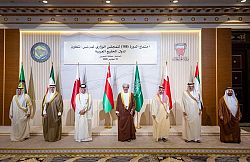
GCC's Ministerial Council Confirms its Support for Yemen's Unity, Sovereignty, Calls for Designating Houthi Militias Terrorist Group
The Gulf Cooperation Council (GCC) affirmed the sovereignty of the Republic of Yemen and the unity of its territory, calling on the UN Security Council to implement its resolutions regarding Yemen and the rebellion of the Iranian-backed Houthi terrorist militias.

GCC Secretary-General Welcomes UN Security Council’s Position on Houthi Attacks Against Saudi Arabia
The Secretary-General of the Gulf Cooperation Council (GCC) Jasem Albudaiwi has expressed his appreciation for the position conveyed by members of the United Nations Security Council in their presidential statement regarding the attacks carried out by the Houthi terrorist militia against the Kingdom of Saudi Arabia.

Brent Crude Futures Rise 12 Cents
Oil prices remained mostly unchanged in early Asian trading on Thursday following gains from the previous session and a sharp monthly increase.

Al Nassr Beat Al Fateh 3-0 in Saudi Football League
Al Nassr defeated Al Fateh 3-0 in the opening round of the Saudi Pro League, known as the Roshn Saudi League.
Last Update: ،
2026/10/19
Time
08:45:12
Latest News:
 Yemeni Ambassador Discusses Escalating Houthi Threats with US Assistant Secretary of State
Zouba, Indonesian Deputy Foreign Minister Discuss Cultural and Educational Cooperation
Government Calls on Security Council to Condemn Houthi Escalation in Yemen
Al-Soqatari, al-Sharjabi Participate in Operational, Technical Mission of Water and Irrigation Management ..
Parliament Speaker Praises Kuwait’s Support for Yemen
Latest News:
Yemeni Ambassador Discusses Escalating Houthi Threats with US Assistant Secretary of State
Zouba, Indonesian Deputy Foreign Minister Discuss Cultural and Educational Cooperation
Government Calls on Security Council to Condemn Houthi Escalation in Yemen
Al-Soqatari, al-Sharjabi Participate in Operational, Technical Mission of Water and Irrigation Management ..
Parliament Speaker Praises Kuwait’s Support for Yemen
$170 million total amounts of withdraws from Saudi deposit to import basic commodity
[03/11/2018 07:07]
ADEN-SABA
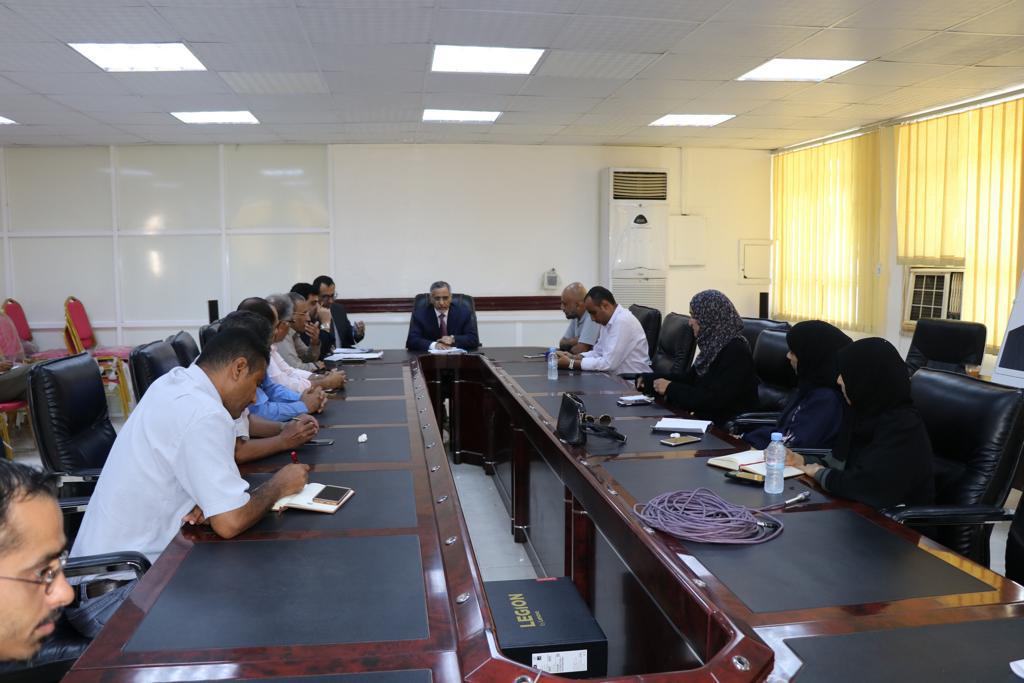
Governor of Central Bank of Yemen (CBY) Mohammed Zemam said the bank approved last week three payments withdraws from Saudi deposit with total sum $170 million. The amount considered to be the fourth and fifth payments and some remaining amounts of the second and third payments.
Zeman told the Yemeni News Agency (Saba) that these amounts distributed to the banks which submitted requests for foreign currency to cover the costs of imports of wheat, rice, sugar, milk and corn.
He stated that Yemeni Rial (YR) exchange rate is 585 (YR) for $1 dollar to import basic commodity.
Zeman explained that the $170 million distributed as follow: $98 million, 162, 515 for wheat, $33 million, 321, 026 for rice, $20 million, 374,512 for sugar, $1 million, 720,000 for milk, $12 million, 722,915 for cooking oil and $3 million, 626,612 for corn.
He stated that mechanism of withdraw from the Saudi deposit has become clear and easy thanks for cooperation by Saudi Finance Ministry.
" CBY now is processing two payments per week to get approval that only takes five day work", Zemam said.
The CBY held a meeting Saturday with Managers of banks in the temporary Aden devoted to discuss several topics relating to banking sector business.
Key words:
SABA Governor - distributed - cooperation - processing - considered - mechanism - explained - commodity - submitted - remaining -
Yemeni Ambassador Discusses Escalating Houthi Threats with US Assistant Secretary of State
Zouba, Indonesian Deputy Foreign Minister Discuss Cultural and Educational Cooperation
Al-Khanbashi Praises UNDP Interventions in Hadramout
Iraqi Prime Minister Receives Foreign Minister
Yemen Welcomes European Council's Statement on Houthi Terrorist Militias' Escalation
Foreign Minister: Tehran Regime Party to War on Yemenis, Not Mediator
Foreign Minister Holds Talks with Indonesian Counterpart on Yemen, Regional Developments
President al-Alimi Discusses National and Regional Developments with UK Foreign Secretary
UN Security Council Condemns Houthi Escalation in Yemen, Reaffirms Saudi Arabia’s Right to Self-Defence
President al-Alimi asks about Colleagues' Safety Following Houthi Missile Attack on Maashiq Palace