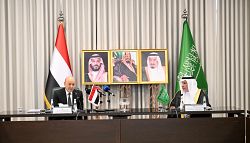
President al-Alimi Launches Package of Relief Projects from King Salman Center to Support Taiz's Resilience, Help those Affected Across Yemen
His Excellency President Dr. Rashad al-Alimi, Chairman of the Presidential Leadership Council (PLC), visited today, Tuesday the King Salman Center for Relief and Humanitarian Work. He was received by Dr. Abdullah al-Rabeeah, Advisor at the Royal Court and General Supervisor of the Center, Saudi Arabia's Ambassador to Yemen, Mohammed al-Jaber, along with several leaders of the center and its partners in relief and humanitarian work.
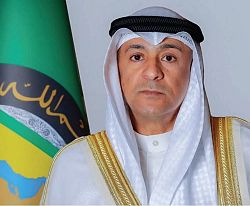
GCC Secretary-General Welcomes UN Security Council’s Position on Houthi Attacks Against Saudi Arabia
The Secretary-General of the Gulf Cooperation Council (GCC) Jasem Albudaiwi has expressed his appreciation for the position conveyed by members of the United Nations Security Council in their presidential statement regarding the attacks carried out by the Houthi terrorist militia against the Kingdom of Saudi Arabia.

Brent Crude Futures Rise 12 Cents
Oil prices remained mostly unchanged in early Asian trading on Thursday following gains from the previous session and a sharp monthly increase.

Al Nassr Beat Al Fateh 3-0 in Saudi Football League
Al Nassr defeated Al Fateh 3-0 in the opening round of the Saudi Pro League, known as the Roshn Saudi League.
Last Update: ،
2026/10/28
Time
03:04:03
Latest News:
 Yemeni Ambassador Discusses Developments in Yemen with Czech Parliament Speaker
Aden Governor Discusses with UNICEF Strengthening Interventions in Water, Education
Green Climate Fund Approves Project Worth $28 Million to Develop 'CWIMEWS' in Yemen
Yemen, China Discuss Development and Humanitarian Cooperation
President al-Alimi Calls on Europe to Designate Houthis as Terrorist Organization
Latest News:
Yemeni Ambassador Discusses Developments in Yemen with Czech Parliament Speaker
Aden Governor Discusses with UNICEF Strengthening Interventions in Water, Education
Green Climate Fund Approves Project Worth $28 Million to Develop 'CWIMEWS' in Yemen
Yemen, China Discuss Development and Humanitarian Cooperation
President al-Alimi Calls on Europe to Designate Houthis as Terrorist Organization
Killing terrorist Akram Al-Sayed in Marib is a painful blow to Tehran regime
[09/12/2021 12:24]
Riyadh - Saba
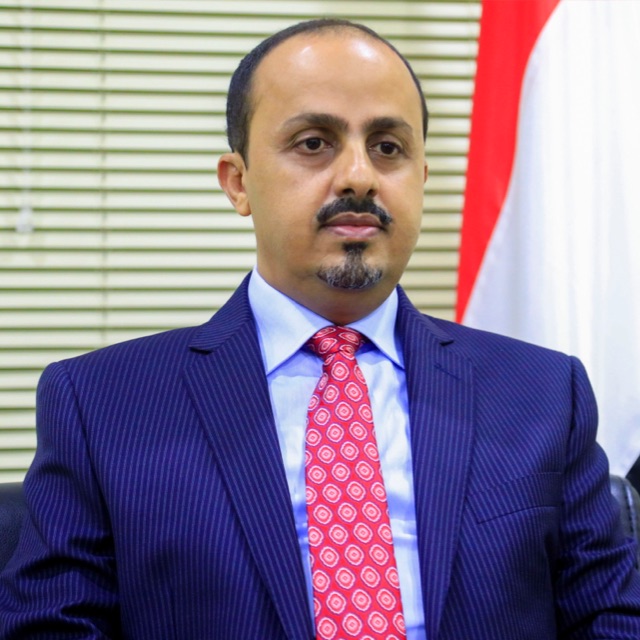
Minister of Information Muammar al-Eryani said, "The killing of the expert and leader of the military wing of the Lebanese Hezbollah, Akram al-Sayed, by artillery bombardment of the National Army on the Umm Rish front in Ma'rib governorate, is a painful blow to the Tehran regime and its sectarian militias."
He said it is also a new indication of al-Sayed's leadership of military operations in the governorate, and what the Marib battle represents to Iran's expansion project in the region."
He said that the expert and leader of the Hezbollah militia, Akram al-Sayed entered Yemen in August 2017 as part of a group of terrorists affiliated with the party, and on December 3, he was sent with a number of party experts to the fronts south of Marib, sectors of "Dana, Juba, Mala'a" to lead operations and implement Iranian scheme to escalate the pace of confrontations in the province.
Al-Eryani indicated that the terrorist was killed along with the leader of the Houthi militia called Abu Ashraf al-Asadi and eight members of the militia, and his body was evacuated on board an ambulance to the al-Juba area, before it was transferred to the governorate of Saada, where the burial of dozens of bodies is taking place.
Minister of Information Muammar al-Eryani said, "The killing of the expert and leader of the military wing of the Lebanese Hezbollah, Akram al-Sayed, by artillery bombardment of the National Army on the Umm Rish front in Ma'rib governorate, is a painful blow to the Tehran regime and its sectarian militias."
He said it is also a new indication of al-Sayed's leadership of military operations in the governorate, and what the Marib battle represents to Iran's expansion project in the region."
He said that the expert and leader of the Hezbollah militia, Akram al-Sayed entered Yemen in August 2017 as part of a group of terrorists affiliated with the party, and on December 3, he was sent with a number of party experts to the fronts south of Marib, sectors of "Dana, Juba, Mala'a" to lead operations and implement Iranian scheme to escalate the pace of confrontations in the province.
Al-Eryani indicated that the terrorist was killed along with the leader of the Houthi militia called Abu Ashraf al-Asadi and eight members of the militia, and his body was evacuated on board an ambulance to the al-Juba area, before it was transferred to the governorate of Saada, where the burial of dozens of bodies is taking place.
Key words:
confrontations - Saba Minister - transferred - governorate - bombardment - Information - represents - terrorists - indication - affiliated -
President al-Alimi Launches Package of Relief Projects from King Salman Center to Support Taiz's Resilience, Help those Affected Across Yemen
Yemeni Ambassador Discusses Developments in Yemen with Czech Parliament Speaker
Aden Governor Discusses with UNICEF Strengthening Interventions in Water, Education
Green Climate Fund Approves Project Worth $28 Million to Develop 'CWIMEWS' in Yemen
Yemen, China Discuss Development and Humanitarian Cooperation
President al-Alimi Calls on Europe to Designate Houthis as Terrorist Organization
Report Documents Houthi Violations Against 107 Women and Children in Taiz
Yemenia Aircraft Makes Safe Landing in Jordan After Hail Strike
Coalition Intercepts and Destroys Four Drones and Three Ballistic Missiles Launched by Houthis Toward Saudi Arabia
Yemeni Rights Network Documents 42 Houthi Violations in Taiz in 48 Hours