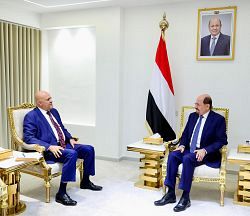
Prime Minister directs concerned authorities to help floods-affected people in Taiz governorate
The Prime Minister Dr. Shaya Zindani directed the concerned authorities to address material damages caused by heavy rainfalls and floods in Taiz governorate.
Arab League Calls for Confronting Rising Anti-Muslim Hate
The Arab League on Sunday called for intensified international efforts to confront the growing phenomenon of hate speech and discrimination against Muslims in order to prevent deeper divisions among religions and cultures.

Italy budget deficit at 3 percent
Italy recorded a deficit in its general budget of 3.1 percent of GDP in 2025, thus exceeding the ceiling set by the European Union at 3 percent.
Saudi League: Al-Nassr, Al-Ettifaq and Neom Secure Victories Over Al-Ittihad, Damac and Al-Riyadh
Al-Nassr defeated its guest Al-Ittihad 2–0 in the match that brought them together at Al-Awwal Park Stadium in Riyadh, as part of the 21st round of the Saudi Professional League.
Last Update: ،
2026/04/12
Time
07:35:50
Latest News:
 PM launched Anti-Corruption Workshop in Aden
About 200 Yemeni organizations condemn repeated Iranian attacks on Gulf States, Jordan
President al-Alimi: It's important to build on deterring Iranian regime to end threat of its militias
MASAM removes 2639 Houthi-laid landmines in 10 days
Coast Guard seizes two boats suspected of human trafficking
Latest News:
PM launched Anti-Corruption Workshop in Aden
About 200 Yemeni organizations condemn repeated Iranian attacks on Gulf States, Jordan
President al-Alimi: It's important to build on deterring Iranian regime to end threat of its militias
MASAM removes 2639 Houthi-laid landmines in 10 days
Coast Guard seizes two boats suspected of human trafficking
YJS holds Houthis responsible for detainees' deteriorated health
[01/04/2017 01:52]
Sana'a (Saba)- The Yemeni Journalists Syndicate (YJS) has held the militias of the Houthi-Saleh coup responsible for the deteriorated health of the detained journalists held inside their custodies.
A member of the Yemeni Journalists Syndicate's council Nabil al-Osaidi told the Yemeni News Agency (Saba) that YJS obtained information that the journalist Tawfeeq al-Mansouri's health has extremely deteriorated.
Al-Osaidi spelt out that al-Mansouri is suffering from heart illness, shortness of breath, prostatic hyperplasia, citing that these diseases paralyzed his movement and that he is still without any health care.
The other journalists held at custodies of the Houthi-Saleh militias suffer from bad detention conditions, al-Osaidi added.
Al-Osaidi demanded to immediately take al-Mansouri to hospital to be treated and release all detainees, shouldering the Houthi-Saleh militias responsible for torture, mistreatment and deprivation of being treated or visited by their families.
He called all organizations interested in freedom of expression, particularly the international Federation of Journalists and Federation of Arab Journalists, to express solidarity with the detained journalists and put pressures on the militias to release them.
A member of the Yemeni Journalists Syndicate's council Nabil al-Osaidi told the Yemeni News Agency (Saba) that YJS obtained information that the journalist Tawfeeq al-Mansouri's health has extremely deteriorated.
Al-Osaidi spelt out that al-Mansouri is suffering from heart illness, shortness of breath, prostatic hyperplasia, citing that these diseases paralyzed his movement and that he is still without any health care.
The other journalists held at custodies of the Houthi-Saleh militias suffer from bad detention conditions, al-Osaidi added.
Al-Osaidi demanded to immediately take al-Mansouri to hospital to be treated and release all detainees, shouldering the Houthi-Saleh militias responsible for torture, mistreatment and deprivation of being treated or visited by their families.
He called all organizations interested in freedom of expression, particularly the international Federation of Journalists and Federation of Arab Journalists, to express solidarity with the detained journalists and put pressures on the militias to release them.
Key words:
organizations - international - mistreatment - particularly - deteriorated - deprivation - responsible - Syndicate's - journalists - Journalists -
President al-Alimi: It's important to build on deterring Iranian regime to end threat of its militias
President al-Alimi: Houthi militia’s hostile approach makes regaining state institutions priority
Leadership Council discusses mechanisms for responding to repercussions of local, regional developments
Presidential Leadership Council Member al-Subaihi praises Dutch support for Yemen
PM: Developing official media institutions national priority at this stage
Finance Minister discusses with UN Envoy economic challenges
Presidential Leadership Council Member Dr. Abdullah al-Alimi discusses latest developments with US Ambassador
Member of PLC al-Subaihi discusses with IOM joint cooperation
Deputy Governor Barba’a, Petro Masila CEO reviews activities of Agricultural Value Chain Enhancement Project
Houthi Terrorist Militias landmines kill 1104, injuring 1429 civilians in 9 years—Report