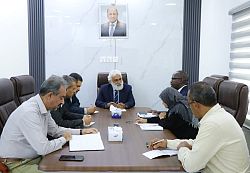
Planning Minister Discusses Strengthening Humanitarian Interventions, Support Projects for Displaced People with UNHCR
Minister of Planning and International Cooperation Mohammed al-Faqmi discussed with Moses Kebrunu, the Acting Program Manager at the UN Refugee Agency (UNHCR) in Yemen, strengthening cooperation on humanitarian and development projects supporting refugees and internally displaced persons (IDPs).
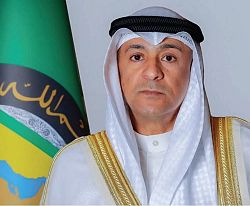
GCC Secretary-General Welcomes UN Security Council’s Position on Houthi Attacks Against Saudi Arabia
The Secretary-General of the Gulf Cooperation Council (GCC) Jasem Albudaiwi has expressed his appreciation for the position conveyed by members of the United Nations Security Council in their presidential statement regarding the attacks carried out by the Houthi terrorist militia against the Kingdom of Saudi Arabia.

Brent Crude Futures Rise 12 Cents
Oil prices remained mostly unchanged in early Asian trading on Thursday following gains from the previous session and a sharp monthly increase.

Al Nassr Beat Al Fateh 3-0 in Saudi Football League
Al Nassr defeated Al Fateh 3-0 in the opening round of the Saudi Pro League, known as the Roshn Saudi League.
Last Update: ،
2026/10/25
Time
03:38:15
Latest News:
 Aden Governor Discusses Humanitarian Cooperation and Sustainable Development Projects with UN OCHA
Aden Governor Discusses Humanitarian Response and Youth Training with UNFPA
Minister of Health Discusses with WFP Nutritional Interventions
Houth Cell, Weapon Shipment in Shabwah, Security Achievement
Ministry of Transport Condemns Houthi Militias for Firing Two Ballistic Missiles on Aden Airport
Latest News:
Aden Governor Discusses Humanitarian Cooperation and Sustainable Development Projects with UN OCHA
Aden Governor Discusses Humanitarian Response and Youth Training with UNFPA
Minister of Health Discusses with WFP Nutritional Interventions
Houth Cell, Weapon Shipment in Shabwah, Security Achievement
Ministry of Transport Condemns Houthi Militias for Firing Two Ballistic Missiles on Aden Airport
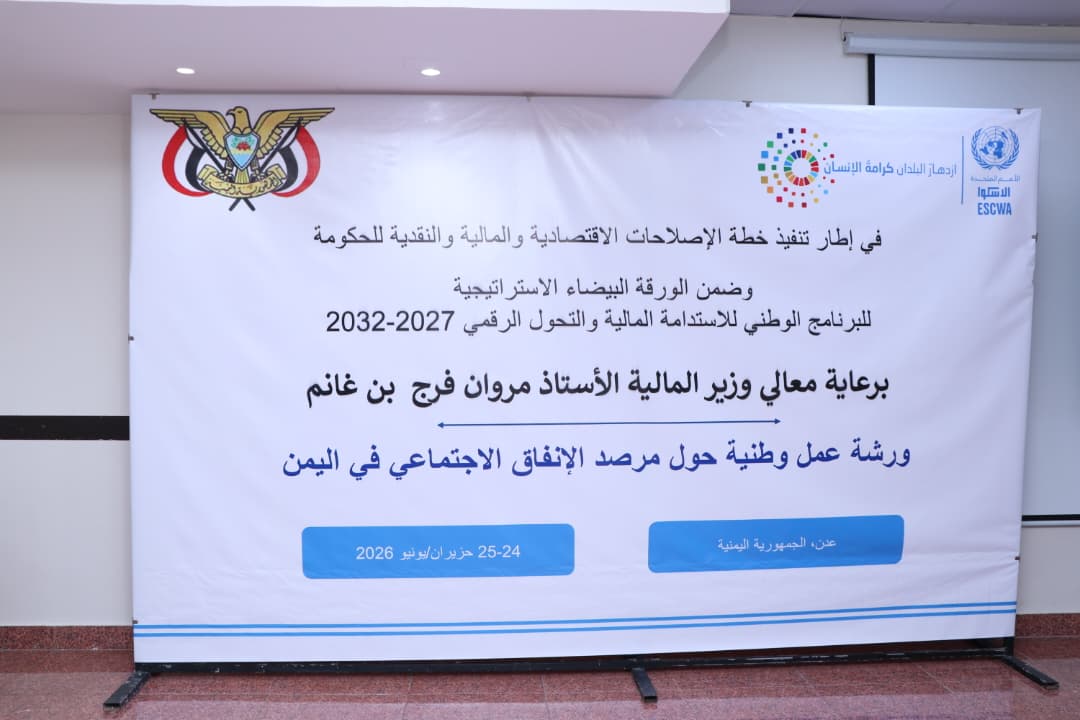
Ministry of Finance Concludes National Workshop on Social Expenditure Observatory in Yemen
[26/06/2026 03:32]
ADEN – SABA
The Ministry of Finance concluded yesterday evening here the activities of the National Technical and Applied Workshop on the Social Expenditure Observatory in Yemen (SEM).
The workshop was organized by the Ministry in cooperation with the United Nations Economic and Social Commission for Western Asia (ESCWA), with the participation of several national government entities and international partners.
The two-day workshop aimed to strengthen national capacities to activate the Social Expenditure Observatory and to link public budget data, actual implementation, and various funding sources with social expenditure dimensions and indicators.
This is intended to contribute to improving the efficiency, equity, and transparency of public spending, while supporting evidence- and data-based decision-making.
The workshop was held as part of the Ministry of Finance’s efforts to enhance transparency and efficiency in public financial management, align social spending with national priorities, and support financial reform and digital transformation efforts.
These initiatives aim to improve financial planning and strengthen fiscal sustainability in Yemen.
During the workshop, extensive technical discussions were held on Yemen’s macroeconomic and fiscal context, public financial management reforms, the structure of the national budget and priorities, and the methodology for linking national budget classifications and functional classifications with the dimensions and indicators of the Social Expenditure Observatory.
The discussions also covered the various areas monitored by the observatory, including education, health and nutrition, social protection, subsidies, agricultural support, housing and community facilities, labor markets and employment, arts, culture and sports, and environmental protection.
Participants also reviewed the data and indicators required to operate and regularly update the observatory.
A dedicated technical session focused on identifying social expenditure outside the framework of the state’s general budget, particularly spending beyond direct budget allocations.
This included independent and affiliated units, special funds, economic units, treasury funds, partner programs, and various financing sources.
This approach aims to enhance the comprehensiveness of the observatory’s data and provide a broader picture of social expenditure in Yemen.
The Ministry of Finance confirmed that the workshop achieved its main objectives by moving from the conceptual framework of the Social Expenditure Observatory toward initial practical steps related to data linkage, identifying data gaps, and agreeing on clear follow-up mechanisms to operate a pilot version of the observatory in the coming period.
At the conclusion of the workshop, participants agreed on several future workstreams, most notably strengthening the institutional framework of the observatory by appointing technical focal points from relevant national entities, reviewing the map of social expenditure data sources and gaps, adopting a methodology to link budget data and functional classifications with the observatory’s dimensions and indicators, and receiving sample data from international partners participating in the workshop in preparation for a pilot integration using actual data.
The participants also emphasized the importance of expanding technical coordination with ministries and sectoral entities that own relevant data, including those responsible for education, health, social protection, labor, statistics, planning, finance, and other sectors related to the observatory’s various dimensions.
The Main Committee for the Social Expenditure Observatory Project, established pursuant to the Minister of Finance’s Decision No. (75) of 2023, serves as the national leading and coordinating body responsible for following up on the workshop’s outcomes, in coordination with ESCWA, international partners, and national data-owning entities.
Participants stressed the importance of continued coordination between government institutions and partners, as well as data exchange through a unified framework, to ensure the establishment of an integrated national database for social expenditure.
Such a database would help track resources allocated to social sectors, assess their efficiency and impact, and direct them toward the groups and sectors most in need.
Key words:
comprehensiveness - Participants - observatory’s - classifications - implementation - sustainability - transformation - macroeconomic - establishment - institutional -
Planning Minister Discusses Strengthening Humanitarian Interventions, Support Projects for Displaced People with UNHCR
Aden Governor Discusses Humanitarian Cooperation and Sustainable Development Projects with UN OCHA
Aden Governor Discusses Humanitarian Response and Youth Training with UNFPA
Minister of Health Discusses with WFP Nutritional Interventions
Houth Cell, Weapon Shipment in Shabwah, Security Achievement
Ministry of Transport Condemns Houthi Militias for Firing Two Ballistic Missiles on Aden Airport
Houthi Militants Kill 64, Hurt 173 Civilians in Taiz Since Last August
Interior Ministry: Houthis Target Coast Guard Facilities in Aden With Three Ballistic Missiles
Yemenis in Brussels Urge EU to Press for End to Taiz Siege
Yemen’s Prime Minister Condemns Terrorist Attack on Church in Jordan