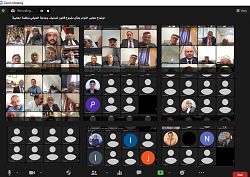
Parliament Reviews Bill to Designate Houthis as Terrorist Organization
The Yemeni House of Representatives on Sunday discussed a draft law designating the Houthi militia as a terrorist organization, amid continued attacks on civilians and escalating violations across Yemen.
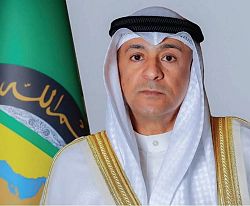
GCC Secretary-General Welcomes UN Security Council’s Position on Houthi Attacks Against Saudi Arabia
The Secretary-General of the Gulf Cooperation Council (GCC) Jasem Albudaiwi has expressed his appreciation for the position conveyed by members of the United Nations Security Council in their presidential statement regarding the attacks carried out by the Houthi terrorist militia against the Kingdom of Saudi Arabia.

EU Allocates 525 Million Euros to Support Startups in Chip Design
European Commissioner for Technological Sovereignty, Security and Democracy, Hana Verkonen, announced that the European Union (EU) has allocated 525 million euros to support startups in the field of chip design.

Al Nassr Beat Al Fateh 3-0 in Saudi Football League
Al Nassr defeated Al Fateh 3-0 in the opening round of the Saudi Pro League, known as the Roshn Saudi League.
Last Update: ،
2026/11/15
Time
07:12:58
Latest News:
 Woman Killed, Eight Civilians Wounded in Houthi Sniper Attacks and Shelling in Taiz
Vice Foreign Minister Discusses Conditions of Yemeni Refugees in Djibouti
Deputy Governor of Taiz Warns of Health Sector Collapse Due to Houthi Blockade
Prime Minister Forms High-Level Committee to Oversee IMF-Supported Reform Programme
Six Civilians, Including Two Children, Two Women Injured by Terrorist Houthi Militias Attacks in Taiz
Latest News:
Woman Killed, Eight Civilians Wounded in Houthi Sniper Attacks and Shelling in Taiz
Vice Foreign Minister Discusses Conditions of Yemeni Refugees in Djibouti
Deputy Governor of Taiz Warns of Health Sector Collapse Due to Houthi Blockade
Prime Minister Forms High-Level Committee to Oversee IMF-Supported Reform Programme
Six Civilians, Including Two Children, Two Women Injured by Terrorist Houthi Militias Attacks in Taiz
Parliament Reviews Bill to Designate Houthis as Terrorist Organization
[15/11/2026 07:02]
ADEN-SABA
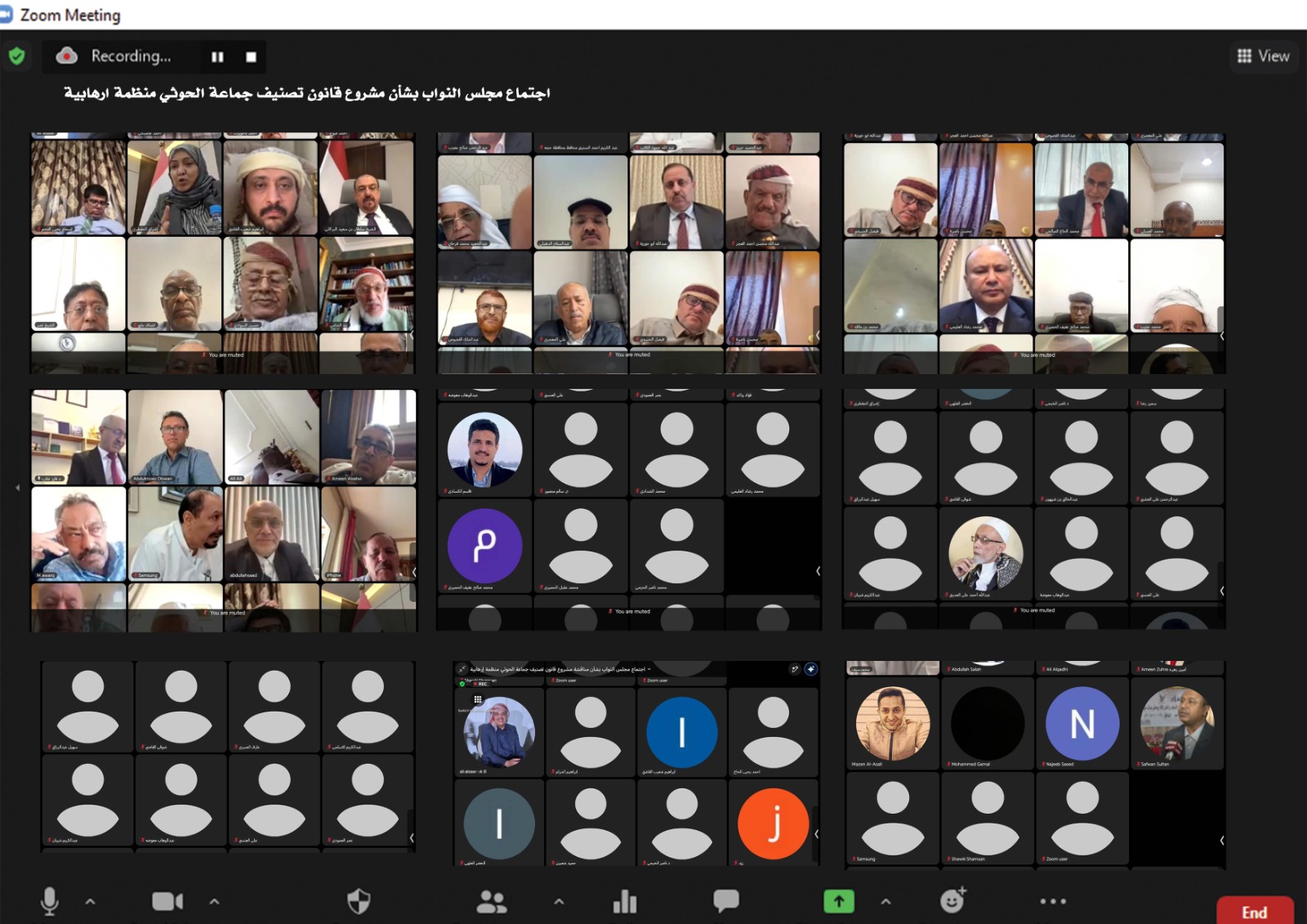
The Yemeni House of Representatives on Sunday discussed a draft law designating the Houthi militia as a terrorist organization, amid continued attacks on civilians and escalating violations across Yemen.
The meeting, chaired by Parliament Speaker Sheikh Sultan al-Barakani and held via video conference, reviewed developments in the country and the militia's attacks on Yemenis in several areas.
Lawmakers discussed the ongoing siege of Taiz, shelling of residential neighborhoods, killings and abuses against civilians, and the denial of access to water, medicine and food. They also addressed Houthi attacks on districts in Taiz and Lahj governorates, as well as strikes targeting the interim capital Aden and its vital, sovereign and civilian facilities.
The militia's attacks in the western coast, Marib, al-Jawf and other areas were also reviewed.
Parliament stressed the need to complete legislative procedures for designating the Houthi militia as a terrorist organization after all opportunities for peace and political solutions had been exhausted.
The draft law was first presented during a parliamentary meeting in Seiyun in April 2019, but a decision was deferred at the time to allow peace efforts to proceed. Lawmakers said the militia had since rejected all peace initiatives and continued its military escalation and attacks across areas under the internationally recognized government's control.
They also condemned Houthi attacks beyond Yemen's borders, including strikes on Saudi Arabia's civilian facilities, economic infrastructure and cities, as well as attempts to target Islam's holiest sites in Mecca and Medina, stressing that such attacks had been condemned internationally.
The meeting said the militia's actions reflected its hostile intentions and its use of missiles, drones and other destructive weapons to undermine security in Yemen, Saudi Arabia and the Gulf states, threatening Arab national security.
It also condemned attacks on civilian airports and economic facilities, along with acts of piracy in the Red Sea, Arabian Sea and Bab al-Mandab Strait, which have disrupted maritime security and harmed the global economy.
Parliament said the militia's continued violations, coupled with Iranian support and its use as a proxy to destabilize the region and target states and their national institutions, made its designation as a terrorist organization a national, regional and international necessity.
It welcomed international positions rejecting Houthi practices and moves by several countries to designate the militia as a terrorist organization, urging other states to follow suit to protect international peace and security, end the bloodshed in Yemen and halt the systematic destruction carried out by the militia in Yemen and Saudi Arabia.
The House of Representatives underscored the importance of approving the draft law and submitting it to the President of the Republic for promulgation, describing the legislation as essential to protecting Yemen and its people, safeguarding regional and international security and stability, and securing maritime routes and global economic interests.
During the meeting, lawmakers also reviewed a report by a special parliamentary committee chaired by Deputy Speaker Engineer Mohsen Basura and comprising heads of parliamentary blocs and members of the Constitutional Committee. The committee had been tasked with examining the draft law submitted by the government, which consists of 55 articles setting out measures and mechanisms for designating the militia, monitoring and verifying its activities, and implementing the resulting legal and executive measures.
The House reviewed the bill article by article, hearing comments and proposals from lawmakers and considering amendments and additions to several provisions.
The proposed legislation, titled the Law on Designating the Houthi Group as a Terrorist Organization and Criminalizing Its Activities and Financing, comprises 55 articles divided into nine chapters.
Chapters One and Two (Articles 1–4) cover the law's title, definitions, objectives, the designation of the Houthi militia as a terrorist organization and the legal consequences of that designation.
Chapter Three (Articles 5–25) criminalizes the militia's activities and establishes severe penalties, including the death penalty, for offenses such as overthrowing state institutions, besieging cities and starving residents, targeting civilians and public facilities, damaging private property and roads, planting landmines, recruiting children, kidnapping and enforced disappearance, attacking international shipping, and financing, arming or supporting the militia.
The chapter also criminalizes promoting ideas of racial or sectarian supremacy, claiming an exclusive divine right to rule for a particular lineage, discrimination based on religion, sect or belief, and the forced displacement of people or attacks on individuals, their property, places of worship and religious institutions.
Chapter Four (Articles 26–36) provides for the establishment of a permanent technical unit within the Office of the Attorney General. The unit would collect information on the militia and affiliated entities, prepare case files on individuals and organizations, and take financial and administrative measures to trace, freeze, confiscate and recover the militia's assets and funds in accordance with the law.
Article 36 provides for the complete nullification of the legal, financial and administrative effects of a range of measures and decisions issued by the militia. These include rulings by courts established or controlled by the Houthis against state officials, political party leaders, political, media and human rights figures, and economic entities; amendments the militia has made to existing laws; and legislation, decisions and appointments issued by entities it established or seized control of.
The article also invalidates confiscation orders involving funds, real estate and other property, as well as subsequent transactions and the seizure of proceeds under the authority of the so-called judicial custodian.
It further addresses changes imposed on school curricula and institutions in what the draft describes as a systematic effort to erase Yemen's national identity, reshape society's cultural fabric and replace the principles of equal citizenship and shared national identity with imported sectarian and lineage-based ideologies.
The provision also covers the use of educational curricula, cultural and educational activities, summer camps and media platforms to promote the militia's ideological and sectarian discourse among younger generations.
Chapter Five (Articles 37–40) focuses on protecting the national economy, legitimate commercial activities, the uninterrupted flow of goods and essential supplies, and humanitarian, medical and relief operations.
Chapter Six (Articles 41–44) sets out judicial jurisdiction, investigation and trial procedures, and related legal safeguards. Chapter Seven (Articles 45–47) addresses the international prosecution of Houthi leaders and those involved in their crimes, as well as judicial cooperation, the exchange of information and evidence, and the tracing and recovery of assets.
Chapter Eight (Articles 48–51) covers criminal liability and the protection of victims' and affected persons' rights, while Chapter Nine (Articles 52–55) contains final provisions governing implementation, the issuance of executive regulations and publication of the law.
Article 54 stipulates that crimes committed by the militia before the law's enactment would be punishable under Islamic law or existing legislation, whichever carries the harsher penalty.
The meeting began with a review and approval of the minutes of the previous session. Parliament will continue deliberations on the draft law and complete the procedures required for its final approval.
Government officials attending the meeting included Minister of Legal Affairs Judge Ishraq al-Maqtari, Minister of State for Parliamentary Affairs Dr. Abdullah Abu Huriya, and Interior Ministry Inspector General Dr. Faez Ghallab.
Key words:
internationally - Representatives - discrimination - Government - Parliament - implementation - administrative - infrastructure - Constitutional - establishment -
Parliament Reviews Bill to Designate Houthis as Terrorist Organization
Woman Killed, Eight Civilians Wounded in Houthi Sniper Attacks and Shelling in Taiz
Vice Foreign Minister Discusses Conditions of Yemeni Refugees in Djibouti
Prime Minister Forms High-Level Committee to Oversee IMF-Supported Reform Programme
Six Civilians, Including Two Children, Two Women Injured by Terrorist Houthi Militias Attacks in Taiz
Rasd Organization: Over 123 Landmine Casualties in Taiz, Western Coast
Yemen’s Water Minister Discusses Strengthening Partnerships with UNOPS, IOM
Yemen Condemns Israeli Bombing of Nasser Medical Complex in Gaza
Yemen Expresses Solidarity with Türkiye Over Military Helicopter Crash
GCC Chief Welcomes UN Security Council Resolution Calling on Houthis to End Escalation