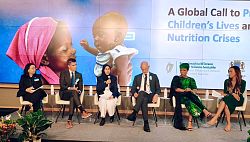
Foreign Minister Stresses Investment in Children, Protection of Health and Nutrition Services
Foreign Minister and Expatriates Dr. Afrah al-Zouba stressed the need to increase national investment in children and ensure the continuity of essential services amid mounting economic and humanitarian challenges and the impact of Houthi escalation on civilians.
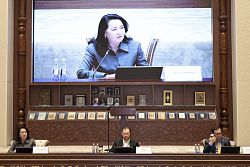
Second Day of International Media Forum on Islamic Civilization Kicks Off in Tashkent
The second day of the International Media Forum “Islamic Civilization: A New Perspective – New Discoveries” commenced today, Wednesday, at the Center for Islamic Civilization in the Uzbek capital, Tashkent.

Gold Rises Over 1 Percent
Gold prices rose more than one percent today, Thursday, as investors digested the U.S. interest rate hike and hints of further monetary tightening, while the rally in oil prices came to a halt.

Al Nassr Beat Al Fateh 3-0 in Saudi Football League
Al Nassr defeated Al Fateh 3-0 in the opening round of the Saudi Pro League, known as the Roshn Saudi League.
Last Update: ،
2026/09/25
Time
07:34:28
Latest News:
 Yemeni Minister Meets German Parliament Committee
Al-Alimi, Arab League Chief Discuss Yemen and Arab National Security
Yemen Participates in LDC Foreign Ministers’ Meeting, Calls for Increased International Support
National Commission for Investigation Meets with EU, Dutch Missions in Geneva to Discuss Developments ..
Foreign Minister Praises Germany’s Stance Against Houthi Attacks, its Contribution to Protecting Freedom ..
Latest News:
Yemeni Minister Meets German Parliament Committee
Al-Alimi, Arab League Chief Discuss Yemen and Arab National Security
Yemen Participates in LDC Foreign Ministers’ Meeting, Calls for Increased International Support
National Commission for Investigation Meets with EU, Dutch Missions in Geneva to Discuss Developments ..
Foreign Minister Praises Germany’s Stance Against Houthi Attacks, its Contribution to Protecting Freedom ..
YCMHRV calls for Yemen peace based on the three basic references
[02/03/2018 01:49]

GENEVA-SABA
A Yemeni activist with the Humanitarian Coalition for Monitoring Human Rights Violation (YCMHRV) has called on the UN Human Rights Council and the UN office to take serious measures to stop the war Yemen by forcing the implementation of the three basic references of peace; the GCC Initiative, the UNSC resolutions mainly resolution no. 2216 and the outcomes of the National Dialogue Conference.
In a presentation at a seminar held on the sideline of the UNHRC's 37th session in Geneva on Thursday, Basem al-Haj said "The phenomenon of terrorism has evolved in an unprecedented way in Yemen." " It has evolved from a group terrorism to a state terrorism," he elaborated, pointing to the former deep state of Ali Abdullah Saleh and Houthis that mounted a coup and unleashed an unprecedented violence to prevent Yemen's transformation to a democratic state.
"The Houthi militia's coup of September 2014 derailed the conciliatory political process and the militia practiced the most brutal forms of material and morale terrorism to hijack the state and rule the roost," he said.
He said that thousands of Yemenis have been killed, injured or displaced, and are victims of this belligerent group.
A Yemeni activist with the Humanitarian Coalition for Monitoring Human Rights Violation (YCMHRV) has called on the UN Human Rights Council and the UN office to take serious measures to stop the war Yemen by forcing the implementation of the three basic references of peace; the GCC Initiative, the UNSC resolutions mainly resolution no. 2216 and the outcomes of the National Dialogue Conference.
In a presentation at a seminar held on the sideline of the UNHRC's 37th session in Geneva on Thursday, Basem al-Haj said "The phenomenon of terrorism has evolved in an unprecedented way in Yemen." " It has evolved from a group terrorism to a state terrorism," he elaborated, pointing to the former deep state of Ali Abdullah Saleh and Houthis that mounted a coup and unleashed an unprecedented violence to prevent Yemen's transformation to a democratic state.
"The Houthi militia's coup of September 2014 derailed the conciliatory political process and the militia practiced the most brutal forms of material and morale terrorism to hijack the state and rule the roost," he said.
He said that thousands of Yemenis have been killed, injured or displaced, and are victims of this belligerent group.
Key words:
implementation - transformation - unprecedented - Humanitarian - conciliatory - presentation - resolutions - belligerent - elaborated - Initiative -
Foreign Minister Stresses Investment in Children, Protection of Health and Nutrition Services
Al-Alimi, Arab League Chief Discuss Yemen and Arab National Security
Foreign Minister Praises Germany’s Stance Against Houthi Attacks, its Contribution to Protecting Freedom of Navigation
Local Authority in Marib Signs Memorandum of Understanding with British Organization to Fund, Implement Water Sector Project
Al-Alimi Discusses Yemen Developments, Red Sea Security with EU Official
President al-Alimi: Armed Forces Capable of Taking Lead in Fighting, Eliminating Houthi Threat
Minister Discusses Displacement and Irregular Migration With IOM Chief
Dr. Bawazir Confers with British Minister of State over Developments in Yemen, Houthi Military Escalation
Taiz Governor: Province Will Not Bow or Allow Its Security to Be Undermined
Coalition Spokesman : Six Ballistic Missiles Fired by Houthi Terrorist Militias were Intercepted, Destroyed