
Taiz Residents Bury 18 Victims of Houthi Shelling
Residents of Taiz Governorate on Friday buried 18 victims, most of them civilians, including Mushira and her father, who were killed when Iranian-backed Houthi militias shelled their home on Mount Saber.

GCC Secretary-General Welcomes UN Security Council’s Position on Houthi Attacks Against Saudi Arabia
The Secretary-General of the Gulf Cooperation Council (GCC) Jasem Albudaiwi has expressed his appreciation for the position conveyed by members of the United Nations Security Council in their presidential statement regarding the attacks carried out by the Houthi terrorist militia against the Kingdom of Saudi Arabia.

Brent Crude Futures Rise 12 Cents
Oil prices remained mostly unchanged in early Asian trading on Thursday following gains from the previous session and a sharp monthly increase.

Al Nassr Beat Al Fateh 3-0 in Saudi Football League
Al Nassr defeated Al Fateh 3-0 in the opening round of the Saudi Pro League, known as the Roshn Saudi League.
Last Update: ،
2026/10/24
Time
07:07:39
Latest News:
 Spain Says Houthi Attacks on Civilian Infrastructure in Yemen and Saudi Arabia Fuel Regional Escalation
Arab League Condemns Houthi Attacks on Saudi Arabia’s King Fahd International Airport
European Parliament Calls for Designating Houthis Terrorist Organization, Confirms its Support for Yemeni ..
Foreign Minister Delivers Message from President al-Alimi to Chinese President
Houthi Militias Bombard Mosque, School in Jabal Saber, South of Taiz
Latest News:
Spain Says Houthi Attacks on Civilian Infrastructure in Yemen and Saudi Arabia Fuel Regional Escalation
Arab League Condemns Houthi Attacks on Saudi Arabia’s King Fahd International Airport
European Parliament Calls for Designating Houthis Terrorist Organization, Confirms its Support for Yemeni ..
Foreign Minister Delivers Message from President al-Alimi to Chinese President
Houthi Militias Bombard Mosque, School in Jabal Saber, South of Taiz
Governor of Taiz Discusses with World Food Program Mechanism for Approving, Distributing Food Parcels
[29/01/2026 05:16]
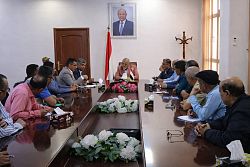
TAIZ – SABA
The Governor of Taiz Governorate Nabil Shamsan discussed Thursday with the Director of the World Food Programme (WFP) Office in the governorate Mohammed Akhlaq Rahmani the mechanism for approving and distributing food baskets, in light of the reduction in the number of beneficiaries due to the decline in humanitarian funding.
Governor Shamsan emphasized the importance of adopting a precise mechanism to review beneficiary data in coordination with district directors, and to address shortcomings that led to the exclusion of eligible families.
Shamsan stressed the need to seek additional funding to include eligible cases, internally displaced persons, and the poorest families, amid the continuation of internal displacement and the repercussions of the war and the crimes of terrorist militias.
He noted that the recent reduction in beneficiaries by around 90,000 families has created a significant humanitarian gap, calling for addressing the issues resulting from the new registration mechanism to ensure assistance reaches those in genuine need.
For his part, the Director of the Governorate’s Relief Committee branch presented a report on the number of beneficiaries over previous years, which reached approximately 179,000 families before being reduced to about 55,000 families, leading to the exclusion of many eligible cases, particularly poor families and those displaced from neighboring governorates.
The Director of the WFP Office affirmed that the new registration mechanism, adopted in cooperation with the Central Statistics Organization, aims to regulate the number of beneficiaries in line with available funding, alongside the implementation of empowerment and livelihood improvement projects to achieve sustainable development.
He praised the cooperation of the local authority and its offices in facilitating the programme’s work and humanitarian interventions.
Meanwhile, the Director of the Office of Planning and International Cooperation reviewed the empowerment and livelihoods project within the framework of the WFP’s new intervention plan, underscoring the importance of strengthening cooperation and coordination between local authority offices and the programme to achieve the desired results in alleviating humanitarian suffering and diversifying sustainable empowerment projects.
During the meeting, district directors emphasized the importance of addressing shortcomings based on clear and accurate criteria for targeting eligible families, and avoiding issues accompanying approval and distribution processes, in a way that ensures fair distribution of aid and expands the scope of beneficiaries.
Key words:
Governorate’s - implementation - programme’s - interventions - Meanwhile - International - repercussions - beneficiaries - approximately - strengthening -
Taiz Residents Bury 18 Victims of Houthi Shelling
Spain Says Houthi Attacks on Civilian Infrastructure in Yemen and Saudi Arabia Fuel Regional Escalation
Arab League Condemns Houthi Attacks on Saudi Arabia’s King Fahd International Airport
European Parliament Calls for Designating Houthis Terrorist Organization, Confirms its Support for Yemeni Government
Foreign Minister Delivers Message from President al-Alimi to Chinese President
Houthi Militias Bombard Mosque, School in Jabal Saber, South of Taiz
Yemeni Foreign Minister Warns of Houthi Threats to Regional and International Security
Rasd Organization: 51 Civilians Killed or Injured in Taiz in One Week
Yemen, Türkiye Discuss Bilateral Relations and Latest Developments
Yemen, Japan Discuss Ways to Strengthen Parliamentary Cooperation